
RETURN OF THE WEASEL
LINER NOTES
Return of the Weasel was composed by Thomas Klepper, who established the framework and provided the fundamental synth and sitar components. Subsequently, Jill Fraser and Peter Grenader integrated an array of electronic elements which punctuate this pulsating, hard driving toe-tapper. To hear the isolated tracks from each individual click here and scroll to the audio samples
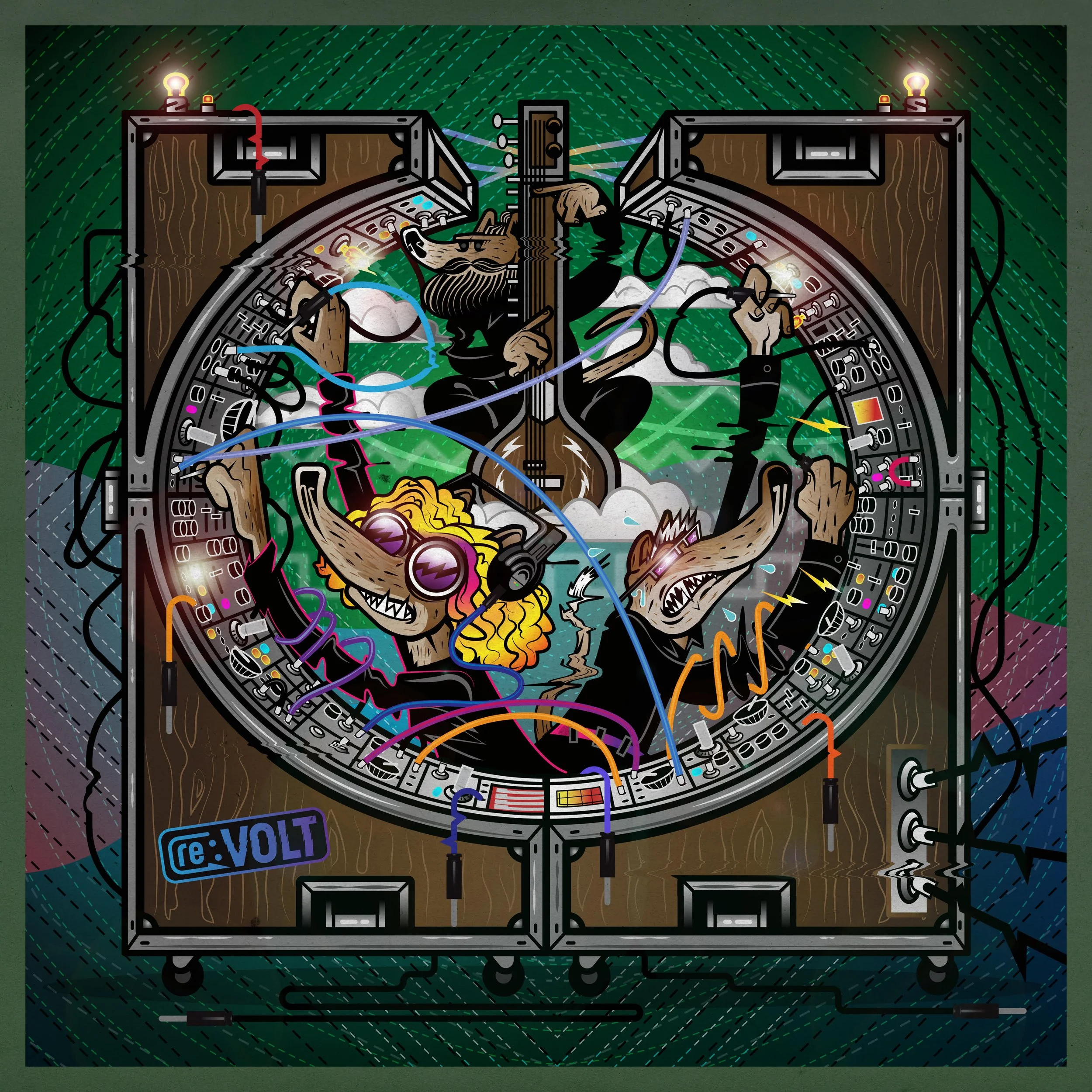
The title is a nod to the infamous Buchla Easel Weasel, underlined by the cover image depicting Jill Fraser, Peter Grenader and Thomas Klepper as weasels.
RETURN OF THE WEASEL
blues for no. 98
Blues for No. 98, composed by Jill Fraser, is framed as a standard 12-bar blues progression in F minor. The piece features an emotive cello performance by Gabe Noel.
The title holds poignant significance: No. 98 was a sea lion pup rescued by the Marine Mammal Care Center in San Pedro, California. Despite the dedicated care provided, the pup succumbed to its injuries. This composition stands as a heartfelt elegy, a musical tribute capturing both sorrow and remembrance, honoring the brief but impactful life of little No. 98.
Fifty One Fifty was composed by Peter Grenader and Jill Fraser. It takes its name from the police code 5150, a designation used for individuals exhibiting psychotic behavior and aptly reflects the essence of the piece, which emphasizes aggressive distortion and chaotic intensity over nuance.
While Fifty One Fifty may be perceived as an entirely electronic work, its foundational sonic material is notably organic. A significant portion of its timbral palette is derived from the sitar: from the fluttering onset drone - which was sculpted via granularization of a single sitar note - to the screaming, feedback-infused lead lines, reminiscent of a prog-metal guitar solo which was achieved through multiple layers of distortion and effects.
fifty one fifty
Galaxy of Galactic Galactica, composed by Peter Grenader, unfolds in classic sonata-allegro A-B-A form. The melody orbits around timbres drawn almost entirely from the sitar, with Grenader’s underlining soundmass built from a single trill that has been fragmented and re-pitched via granular synthesis with the B section modeled after the middle section of Led Zepplin’s Whole Lotta Love. It features Jill Fraser’s melodic clang-tone chimes and Thomas Klepper on both sitar and the contrapuntal cello.
The title is not analogous to the piece. It serves as a tongue-in-cheek nod to electronic music’s long-standing obsession with all things sci-fi. A playful poke at the genre’s tendency to propel itself into the outer reaches of the galaxy to justify it’s own existence.
galaxy of galactic galactica
I Dream of Gort is named for the iconic robot character in the 1951 20th Century Fox film The Day the Earth Stood Still. The composition evolved to its final form incrementally through a series of live performances. It is constructed from two distinct pieces that were subsequently integrated into a single unified work.
Part I features a call-and-response architecture centered around Thomas Klepper's unprocessed surbahar which is echoed in real time through a range of Grenader’s modular processing tools, including the Qu-bit Mojave, EAR Model 27, Mutable Instruments Beads, and the Percussa SSP.
Part II, written by Jill Fraser, began as a MIDI translation of tabla samples, generating rhythmic and melodic materials that gesture toward the modal inflections of the Abhogi raga. At its core lies a fluid dialogue between Thomas Klepper’s expressive sitar and the timbral counterpoint of the Serge synthesizer. This interplay, expressed by layers of processed textures and effects, sustains the hybrid electro-acoustic environment where traditional melodic phrasing pairs with electronics that challenge tradition.
i dream of gort
Kablooey’s foundational motif originates from a modular synthesizer patch created by Peter Grenader in 2018, initially designed for live performance and entitled “There’s No There There.” Components of this patch have been replicated within The Toolbox Modular Synthesizer, notably performed by Danny Carey during Chocolate Chip Trip segments of Tool concerts.
Rising out of Jill Fraser’s opening progression after a minute and a half, the underlying structure of Grenader’s patch begins to unfold. Comprised of an arbitrary selection of 32 distinct samples that are derived from both acoustic and electronic sources, they are subjected to a series of user-selectable processing options, including digital segmentation, rhythmic stuttering, timebase manipulation and randomized modulation of pitch and spatial location.
Soaring above it all Kablooey is bombarded by a cacophony of chaotic sonic events - some electronic, some concrète and some organic, consisting of pitch-modulated whale, dolphin and elephant song.
You can click the links below for a diagram of the Kablooey patch and a short demo video of it’s two main voices . Click here see a diagram of the full 8 voice Kablooey patch
kablooey
production credits
re:volt is:
Jill Fraser: Prism Circuits Serge Modular, 1010 Music Lemondrop and Ableton Push III
Peter Grenader: EAR analog/digital hybrid Modular Synthesizer and Percussa SSP
Thomas Klepper: Sitar, Surbahar, Cello, Digital Sampler, Buchla Music Easel
PRODUCED BY
Peter Grenader and Jill fraser
engineered by
mastered by
TBD
recorded at
Lovely Robot Studio, Happy Accidents Studio and the Tool Loft in Los Angeles between March and August 2025
original cover art by
Skyler King (Prism Circuits)
Aaron Higgins/Steve Joslin (1010 Music)
Bert Schiettecatte (Percussa)
Ivo Ivanov (Glitchmachines)
Sofia Arreguin/Henry Dillon